The Plot Was for Sale. That Didn’t Mean It Could Be Built.
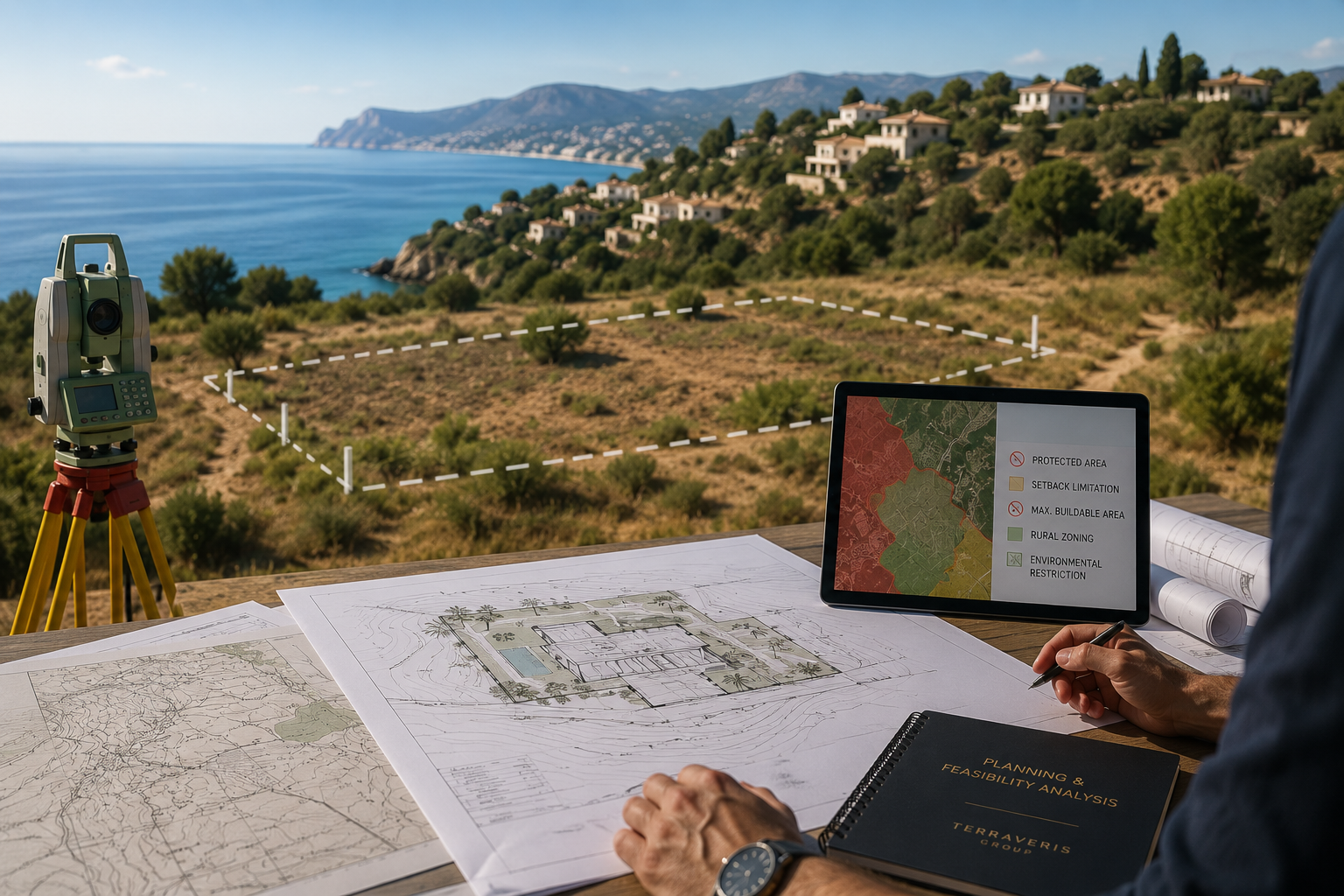
An international buyer contacted Terraveris Group regarding the acquisition of a rural plot in Spain intended for the development of a luxury villa.
At first glance, the opportunity appeared highly attractive.
The land:
offered open views,
had road access nearby,
was surrounded by existing residential properties,
and was being marketed as suitable for development.
The buyer’s intention was straightforward: acquire the plot, develop a high-end residence, and create a long-term lifestyle and investment property.
Based on the listing and initial appearance, the project seemed viable.
However, deeper planning and regulatory analysis revealed a very different reality.
The Assumption Many Buyers Make
One of the most common misconceptions in Spanish real estate is the belief that a plot being offered for sale automatically means it can support the intended construction project.
In practice, this is often not the case.
A plot may:
legally exist,
have neighboring homes,
appear accessible,
and even have utilities nearby,
while still being heavily restricted from a planning perspective.
The key issue is not simply whether construction is possible.
The real question is:
what type of construction is legally permissible on that specific plot?
That distinction can dramatically change the viability of a project.
What the Review Revealed
During the due diligence process, several critical limitations emerged.
1. Minimum Plot Requirements Created Constraints
Planning analysis identified minimum parcel size requirements affecting the property.
Although the plot itself existed legally, the dimensions and planning parameters significantly limited what could actually be developed.
This immediately reduced the feasibility of the buyer’s intended villa concept.
2. Setback Regulations Reduced the Buildable Area
Further review revealed substantial setback requirements from:
neighboring boundaries,
access roads,
and protected surrounding areas.
While the total plot size initially appeared generous, the legally usable construction footprint became far smaller once planning restrictions were applied.
In practice, this meant the project visible in the buyer’s initial architectural concept could not realistically fit within the permitted buildable envelope.
3. Rural Planning Restrictions Limited Development Intensity
The land also fell within a rural planning classification carrying additional restrictions regarding:
maximum buildable surface,
occupancy ratios,
exterior elements,
and future expansion possibilities.
These limitations are frequently underestimated by international buyers unfamiliar with Spanish rural planning frameworks.
The presence of nearby homes often creates the impression that development rights are broadly similar across neighboring plots.
In reality, planning conditions can vary significantly even between adjacent parcels.
4. Infrastructure Availability Did Not Guarantee Development Approval
Utilities and nearby infrastructure were visible in the area, which initially reinforced the perception that development would be straightforward.
However, infrastructure proximity alone does not guarantee:
planning approval,
licensing feasibility,
or technical viability.
Many buyers incorrectly assume that nearby development automatically validates the legal feasibility of a new project.
This is frequently not the case.
The Financial Impact
The implications were substantial.
The buyer was not evaluating the land purely from an aesthetic perspective. The acquisition depended heavily on the ability to construct a specific type of luxury residence.
Once the actual planning limitations became clear:
the architectural concept required major revisions,
projected development costs changed,
usable buildable area decreased,
and the overall investment attractiveness weakened significantly.
The plot itself remained legally valid.
The intended project, however, was no longer realistically achievable in its original form.
Why This Happens Frequently in Spain
Planning regulations in Spain can be highly fragmented and location-specific.
Development potential may depend on:
municipal urban plans,
rural zoning classifications,
environmental protections,
coastal regulations,
infrastructure requirements,
slope limitations,
or parcel dimensions.
As a result, two visually similar plots can carry dramatically different development rights.
This creates significant risk for:
foreign buyers,
investors,
developers,
and clients relying primarily on listings or verbal representations.
What Proper Land Due Diligence Should Verify
A proper pre-acquisition review should analyze:
zoning classifications,
buildability parameters,
setback requirements,
occupancy ratios,
planning limitations,
infrastructure feasibility,
environmental restrictions,
and project compatibility.
This becomes particularly important when evaluating:
rural plots,
coastal land,
luxury villa projects,
or investment-driven developments.
The Key Reality
A plot being marketed as “buildable” does not automatically mean it can support the project a buyer intends to develop.
That distinction can fundamentally alter:
project feasibility,
development costs,
timelines,
financing,
and long-term investment value.
Understanding those limitations before acquisition is often the difference between a viable project and a costly mistake.
Terraveris Group provides independent property due diligence, planning analysis, and acquisition risk assessment for buyers, investors, and developers evaluating real estate opportunities throughout Spain.