When the Property Is Legal — But the Access Isn’t
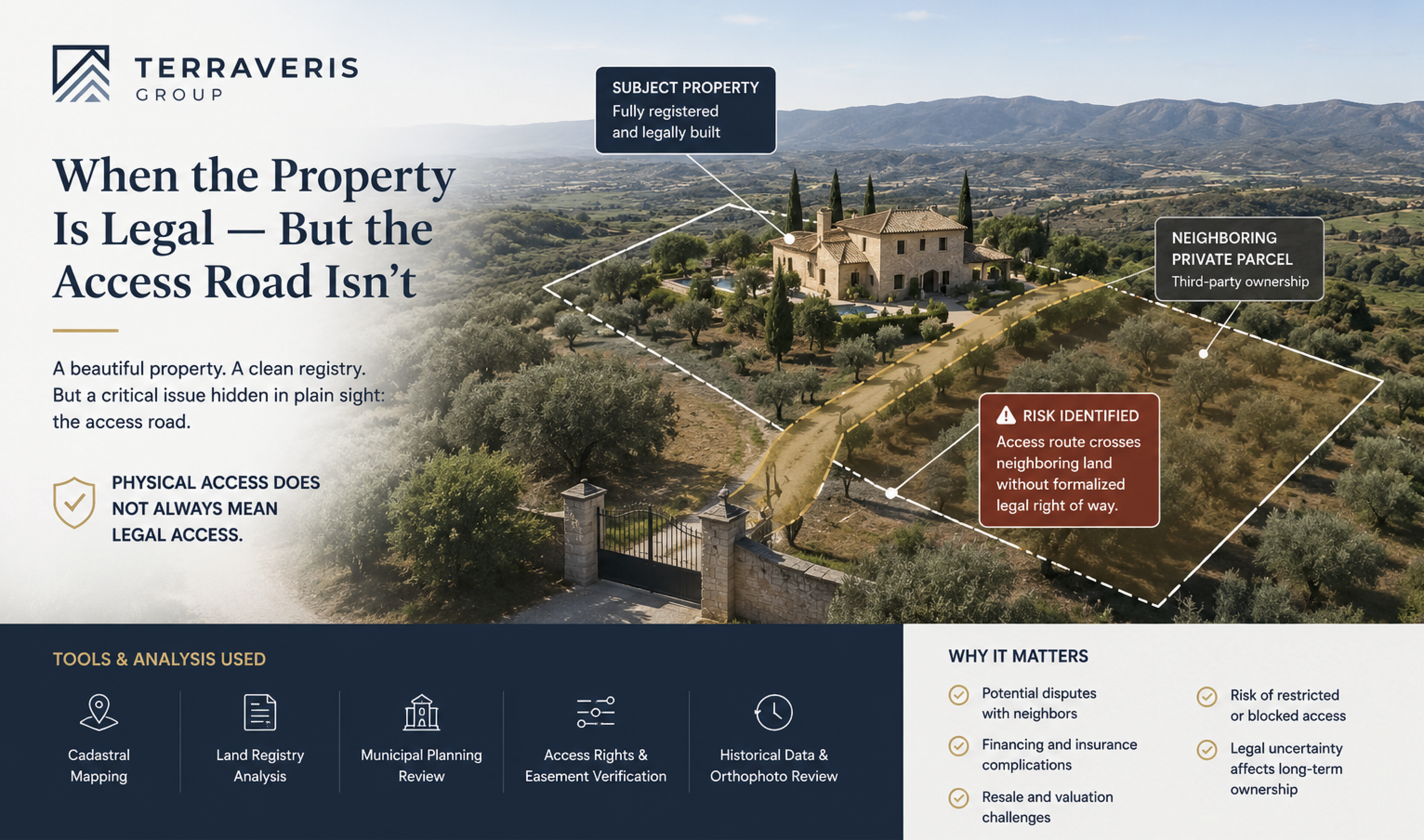
A recent due diligence review in rural Spain revealed a property that appeared fully compliant:
registered dwelling,
declared built area,
updated cadastral records,
completed pool and landscaping,
active utility connections.
At first glance, the acquisition appeared low risk.
However, deeper analysis of:
cadastral maps,
land registry documentation,
municipal planning records,
and access easements
revealed a critical issue:
The main vehicular access route crossed neighboring private parcels without properly formalized legal access rights.
Why This Matters
In many rural properties across Spain, access roads exist physically for decades without:
registered easements,
notarized agreements,
or legally coordinated access rights.
This creates potential risks such as:
disputes with neighboring owners,
blocked or restricted access,
financing complications,
insurance limitations,
resale difficulties,
or legal uncertainty regarding property use.
The Key Problem
The issue is often invisible during normal property visits because:
the road physically exists,
neighboring owners may tolerate usage informally,
and real estate listings rarely mention access structure.
However, from a legal perspective, physical access and legal access are not always the same thing.
What the Investigation Revealed
The review identified:
inconsistencies between cadastral boundaries and actual road use,
missing registered easement rights,
undocumented historical access arrangements,
and reliance on neighboring tolerance rather than enforceable legal rights.
Why Buyers Miss This
International buyers frequently assume:
“If I can drive to the property, the access must be legal.”
In Spain, particularly with:
fincas,
rural estates,
agricultural properties,
and older Mediterranean homes,
that assumption can be dangerous.
Tools Used During the Review
This case involved combined analysis of:
cadastral mapping,
registry extracts,
historical parcel evolution,
orthophoto review,
municipal planning information,
and access-right verification.
No single document alone revealed the full picture.
One of the Most Important Realities in Spanish Property Due Diligence
A property can be physically accessible for years while lacking fully protected legal access rights.
That distinction can materially affect:
property value,
financing,
insurability,
and long-term ownership security.
Terraveris Group provides independent due diligence and property risk analysis for buyers, investors, and developers evaluating real estate opportunities across Spain.