The Pool Was Beautiful. The License Was The Problem.
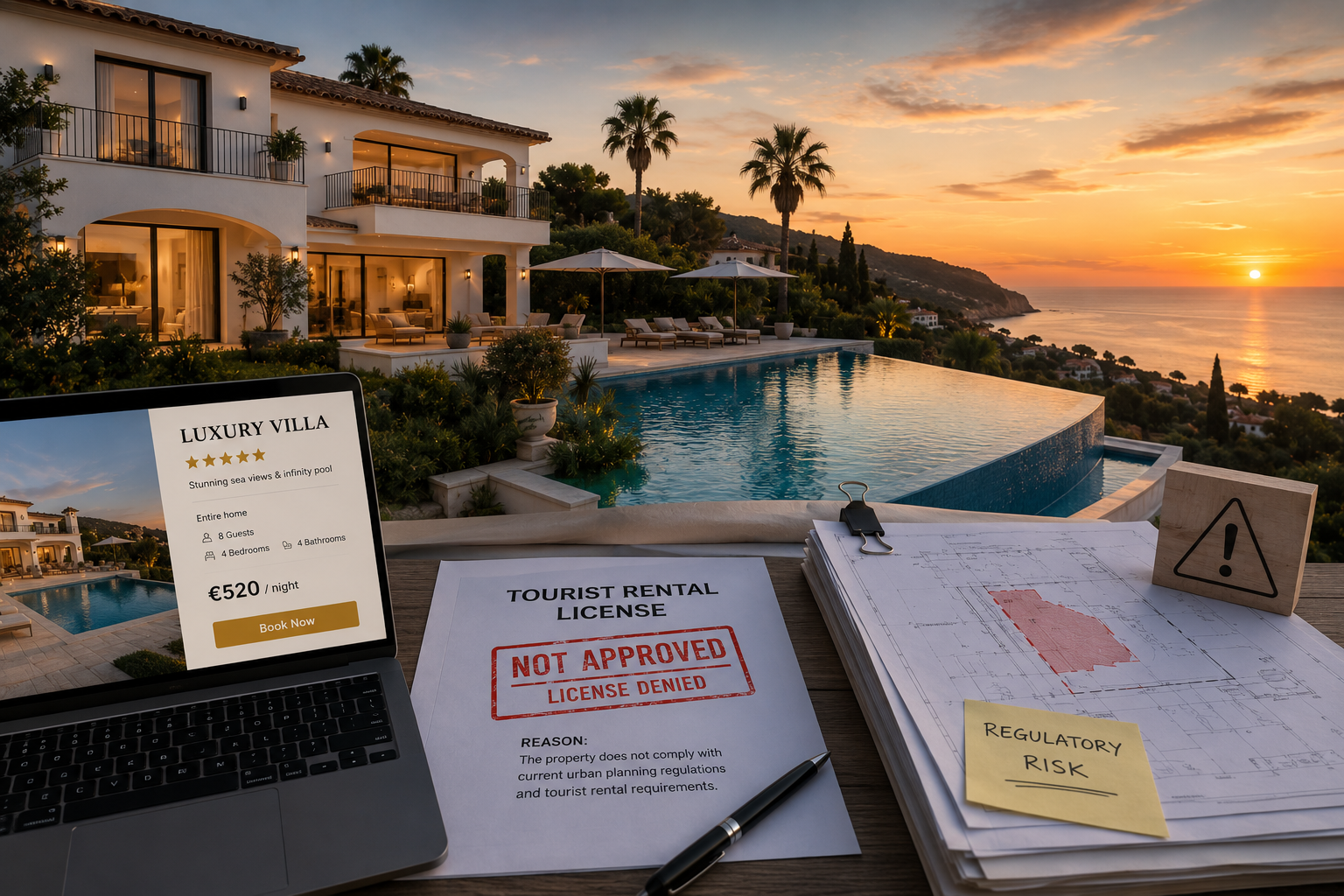
A foreign buyer contacted Terraveris Group regarding the acquisition of a Mediterranean villa in Spain marketed as a “perfect investment opportunity” with strong short-term rental income.
The property checked nearly every box.
An infinity pool overlooking the landscape.
Recent renovations.
Strong seasonal occupancy.
Professional photography.
And an active tourist rental history generating attractive income figures.
The listing heavily emphasized the profitability of the property and presented the tourist rental operation as fully established and transferable to the next owner.
At first glance, the acquisition appeared highly attractive.
But deeper due diligence revealed several important risks connected to the property’s actual long-term rental viability.
The Assumption Many Buyers Make
One of the most common misconceptions among international buyers is assuming that if a property is already operating as a vacation rental, then the legal and licensing situation must also be secure.
In practice, this is often incorrect.
In Spain, a property may appear fully operational for years while still carrying regulatory uncertainty, licensing limitations, or administrative vulnerabilities that only become visible during deeper investigation.
Many buyers mistakenly assume that existing listings, reviews, and bookings automatically guarantee legal continuity.
That assumption can become extremely expensive.
What The Investigation Revealed
During the review process, several concerns emerged regarding the long-term stability of the property’s tourist rental operation.
Certain aspects of the property configuration and documentation raised questions about future licensing certainty and potential regulatory exposure under evolving local rules.
Further analysis also identified inconsistencies between how the property was being commercially marketed and how certain elements appeared reflected in official records and planning documentation.
Importantly, none of these risks were visible during the viewing process.
The villa itself was stunning.
The rental activity appeared legitimate.
The online presence looked professional and well established.
But investment security depends on far more than current occupancy.
Why This Matters
In many parts of Spain, short-term rental regulation has become significantly stricter in recent years.
Properties generating income today may not necessarily enjoy the same operational certainty in the future.
For investors, this creates a critical distinction:
There is a major difference between a property that currently produces rental revenue and a property that is structurally secure as a long-term tourism investment.
That difference is often invisible until an independent review is conducted.
The Value Of Independent Due Diligence
This case was not about obvious illegality or dramatic fraud.
It was about understanding the difference between appearance and long-term operational certainty.
Because in real estate, some of the biggest risks are not hidden inside the property itself.
They are hidden inside the assumptions buyers make about how that property can legally be used in the future.
Terraveris Group provides independent property due diligence and risk analysis for buyers, investors, and developers evaluating real estate opportunities throughout Spain.
Our work focuses on identifying potential risks, inconsistencies, and hidden factors that may not be immediately visible during a standard purchase process — helping clients make more informed and confident decisions before committing to a property acquisition.